Recipe · Fermentation · Entry 01
My Basic
Kimchi
My first working recipe and a collection of early observations. I’m still learning about kimchi, so I’ll keep adding to this entry as I experiment.
The more I read about fermentation, the clearer it becomes that kimchi isn’t a single recipe, or even a single technique, but an entire world of its own.
Recently, while leafing through The Farmhouse Culture Guide to Fermenting, I discovered an astonishing number of variations. I think that, in time, the Fermentation section will grow into a whole chapter devoted to kimchi. I love it far too much to stop at a single recipe.
For now, I’m starting with the basics — the first recipe that consistently works for me, and the one I return to whenever I want to experiment.
Method
Preparation
Salt the cabbage
Rinse the cabbage thoroughly under cold running water and remove any damaged or wilted outer leaves.
I use a quick salting method.
Cut the cabbage lengthwise into quarters. Dissolve 75 g of coarse sea salt in 750 ml of water and pour the brine over the cabbage.
Place a weight on top to keep the cabbage submerged. Leave for about 4 hours, turning the quarters a couple of times.
During this time, the salt draws some of the water out of the cabbage and the leaves gradually become more pliable. By the end of salting, the thick white parts of the leaves should bend easily while still retaining some firmness.
After salting, rinse the cabbage two or three times in cold water to remove excess salt, then allow it to drain thoroughly.
Make the rice paste
Combine the rice flour and water in a small saucepan. Heat, stirring constantly, until the mixture thickens. Once the first large bubbles appear, cook for about one more minute.
Leave to cool completely.
Make the paste
Blend the garlic, ginger, pear and onion until smooth.
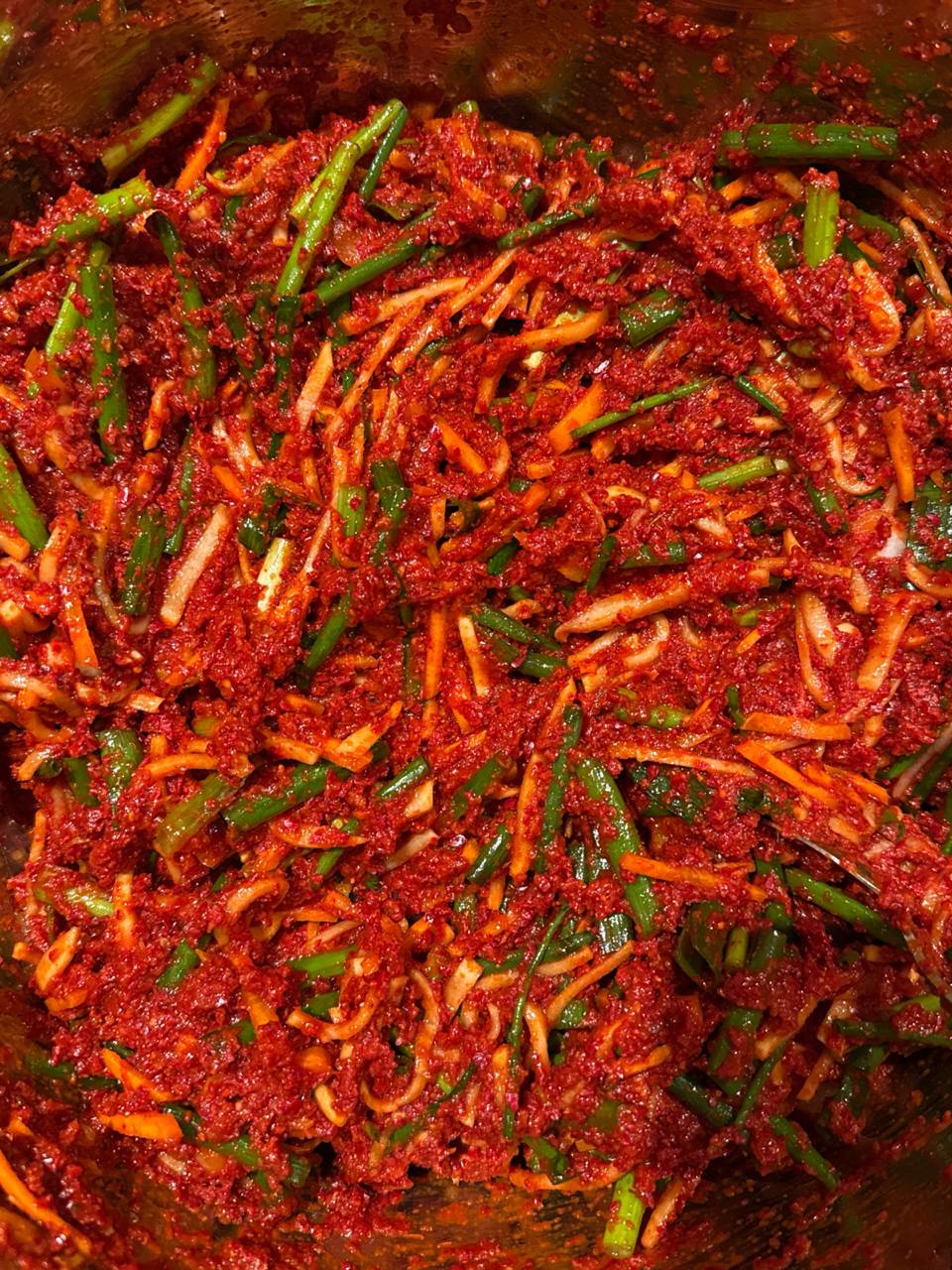
Transfer to a large bowl. Add the gochugaru and cooled rice paste, followed by the daikon, carrot and spring onions. Pour in the fish sauce and soy sauce, add the sugar and mix well.
The paste should be thick and sticky.
Once the paste is ready, I always taste it and adjust the seasoning to my liking. You can add more sugar, bringing the total up to 1 tablespoon — I prefer it that way. If needed, add another 10–20 g of soy sauce as well.
I don’t think of these quantities as a strict formula. What matters more to me is tasting the paste and finding the right balance of saltiness, sweetness and heat.
The amount of gochugaru can also be adjusted slightly to suit your preferred level of heat, but I wouldn’t reduce it dramatically. It does more than add heat — it shapes the flavour of the kimchi itself.
Coat & pack the kimchi
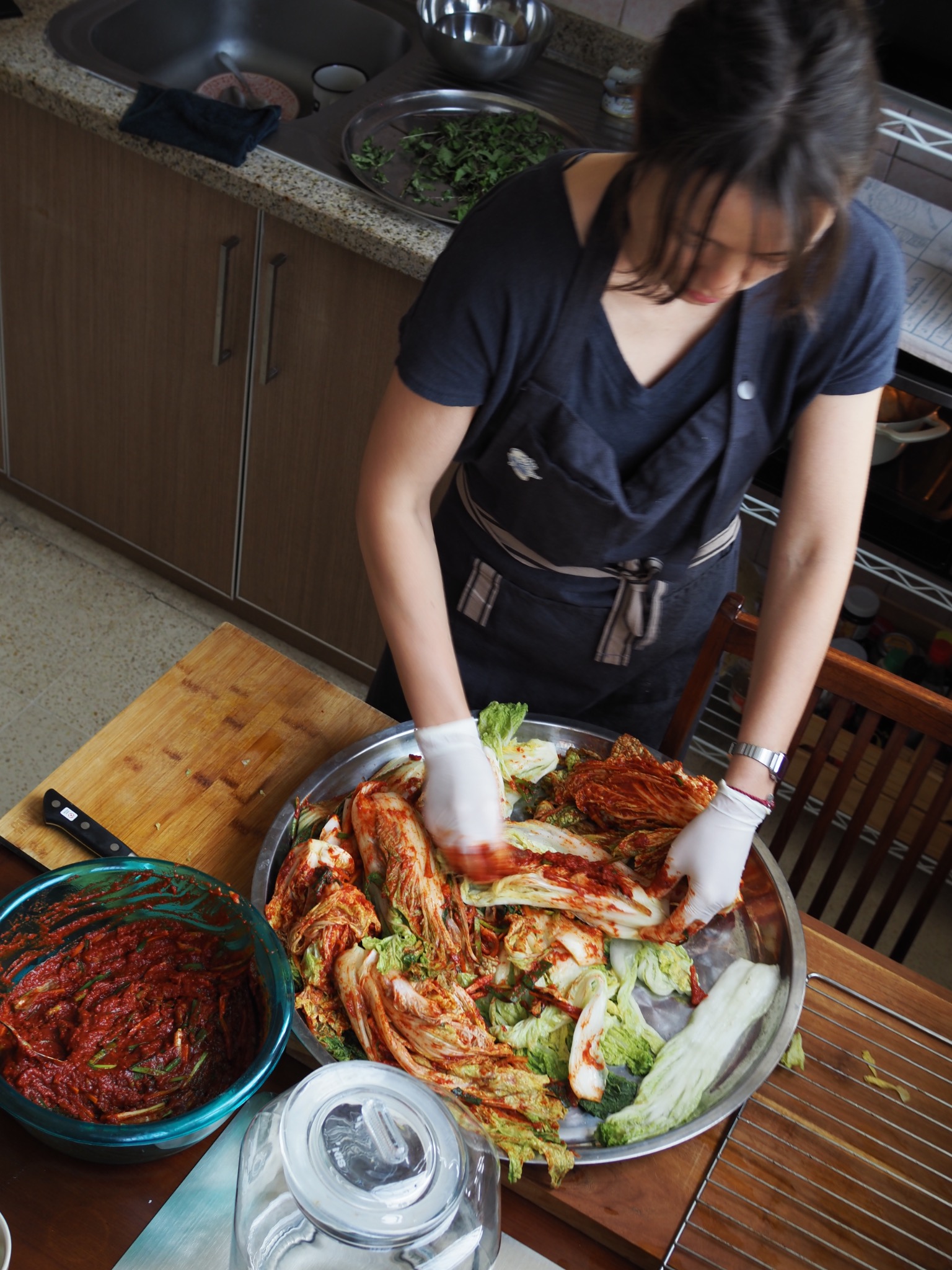
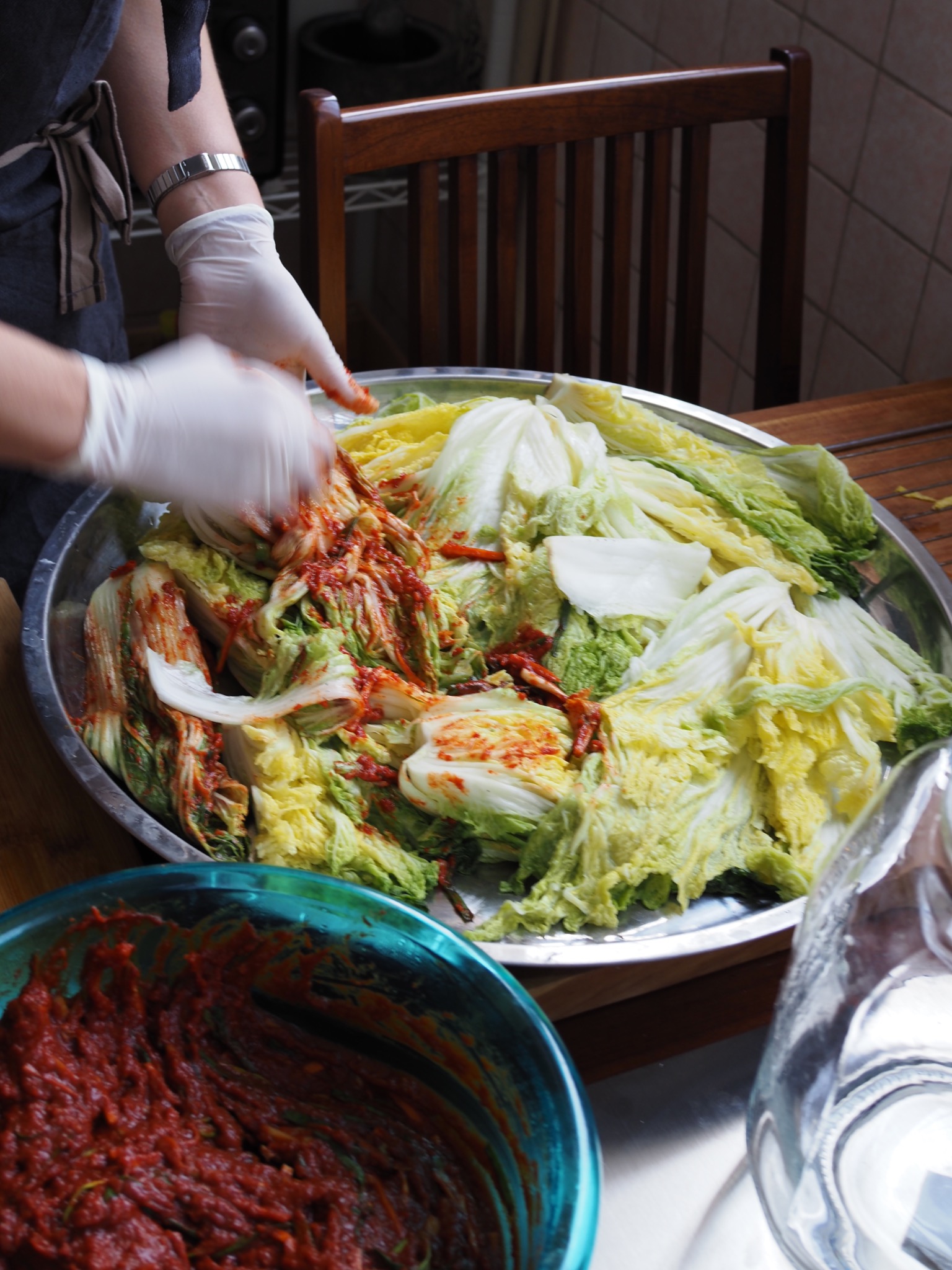
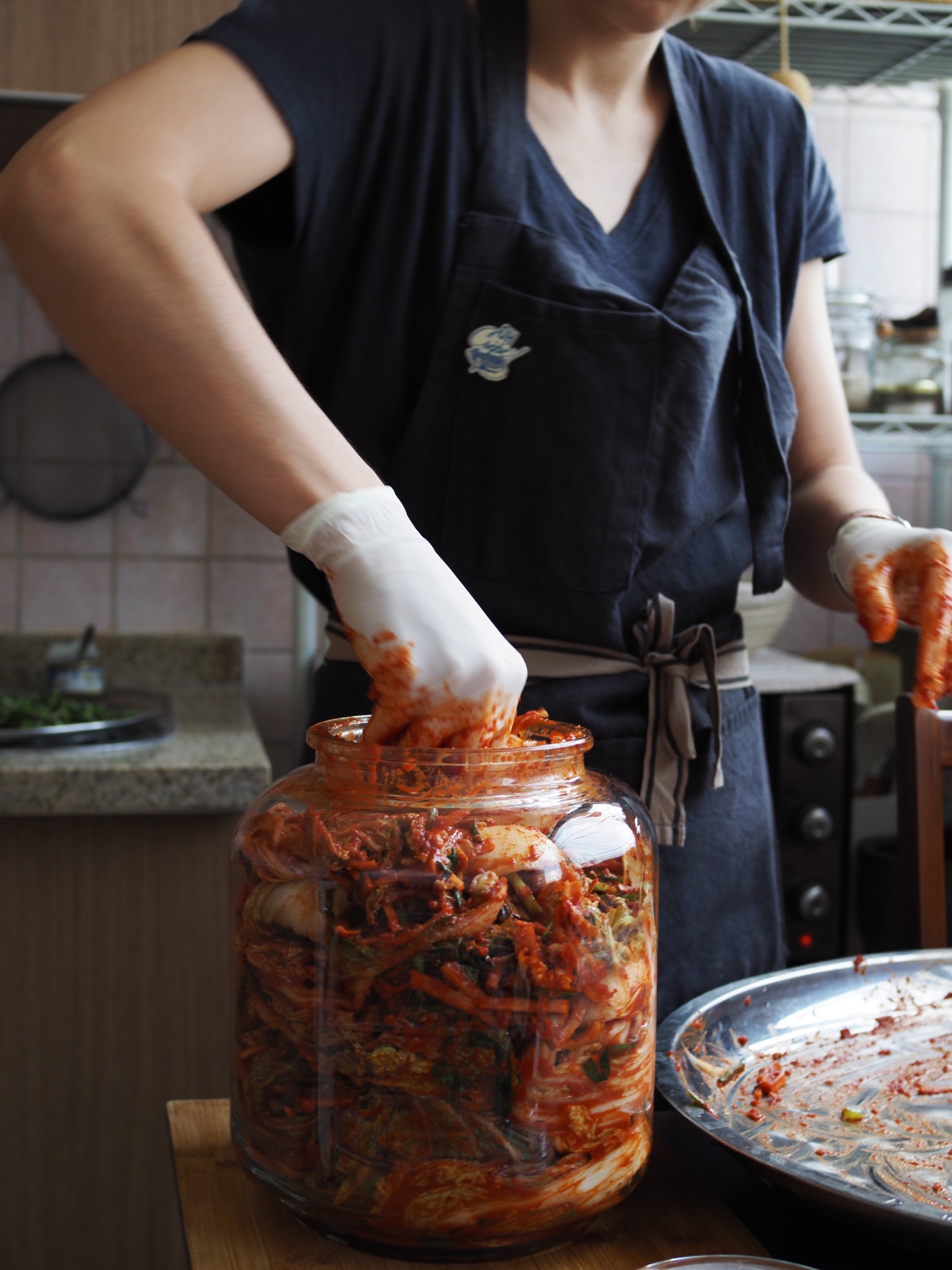
Spread the paste between the cabbage leaves, making sure each layer is well coated. I gently fold each quarter in on itself, taking care not to break the leaves.
Always wear gloves: this amount of chilli can irritate the skin.
Pack the cabbage tightly into a clean glass jar, leaving as few large air pockets as possible. Don’t fill the jar all the way to the top: fermentation releases liquid and produces CO₂, so leave some headspace.
Close the jar with its lid.
Fermentation
The speed of fermentation depends greatly on temperature.
At a room temperature of around 25 °C, fermentation usually becomes noticeably active within the first couple of days. I normally transfer the kimchi to the refrigerator on day 2 or 3.
I don’t rely on time alone. I look for bubbles, more liquid in the jar, the first fermented aromas and a gradual increase in acidity.
Fermentation doesn’t stop in the refrigerator; it simply slows down, and the flavour continues to evolve.
Kimchi can keep for several months in the refrigerator, gradually becoming more sour, softer in texture and deeper in flavour. I prefer it during the first few weeks, while it still tastes relatively fresh. As it matures, it becomes wonderful for cooking — in fried rice, soups or stews.
Kitchen note
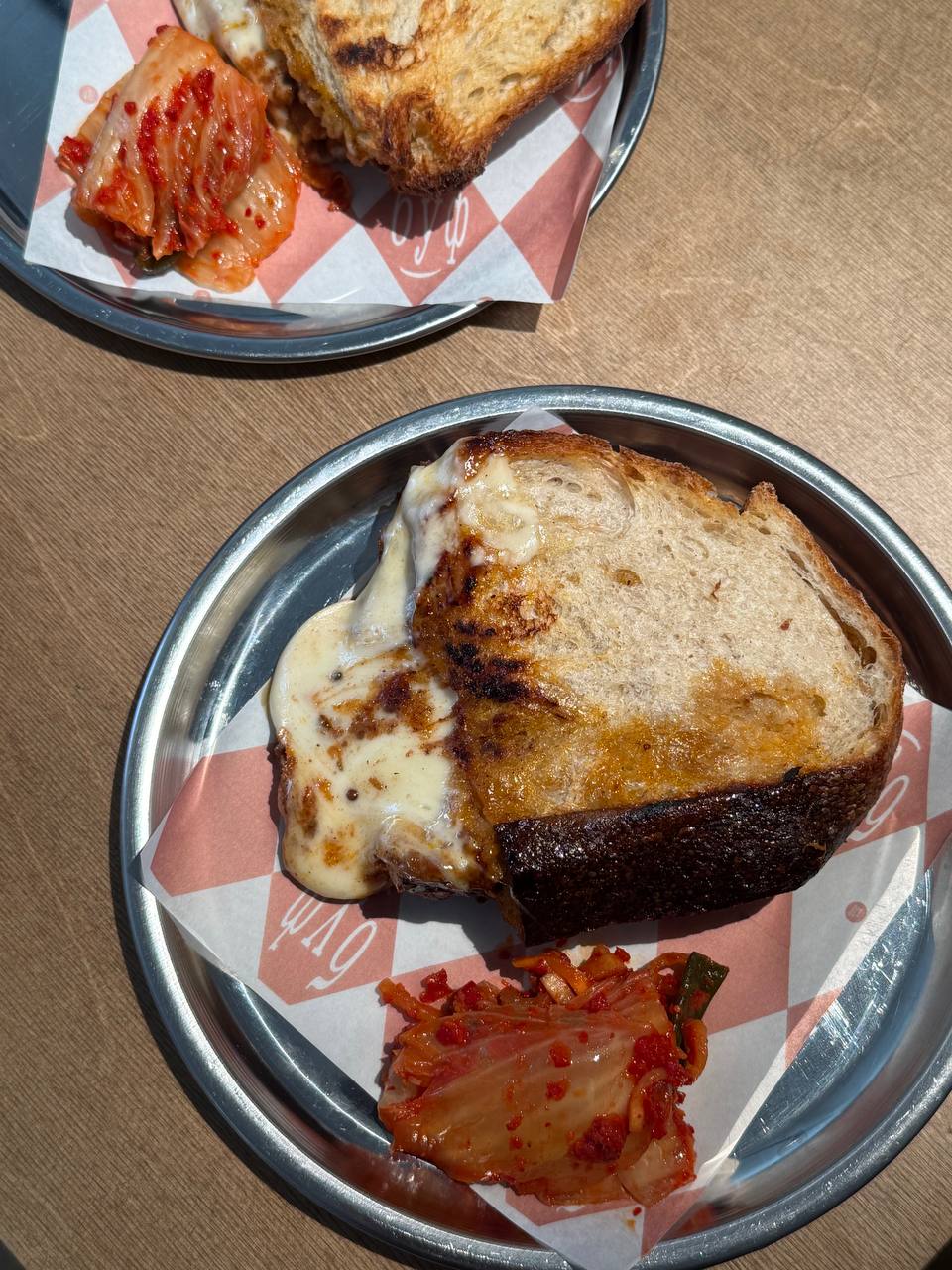
I made this kimchi for Café BUF39 — we served it with a tomato grilled cheese.
It first came together at home through experiments and my own taste preferences, and later became part of a real menu. It was incredibly joyful to see it on a plate beside the sandwich and watch the guests’ reactions.
For me, it was an absolutely priceless exchange of energy.
Back to the journal →︎