Lievito Madre is a traditional firm wheat starter. Unlike the more familiar liquid starters, it contains less water and has the consistency of a firm, pliable dough. It can be used for both bread and enriched pastries.
Lievito Madre — or, as I affectionately call her, Donna Verunity :) — came into my life in March 2026.
Growing one is quite simple: flour, water, a drop of honey, time, and a little patience. Everything that begins afterwards is far more interesting.
How should it be stored? How can you tell when it is strong enough? What do you do if it becomes too acidic? How do you organise feedings when you bake infrequently? And can you do it without ending up with lots of excess starter?
During our first six months together, I got to know the character of my Donna Verunity and found answers to these questions.
Building a Lievito Madre starter
Lievito Madre has 50% hydration. This means that for every 100 g of flour there are 50 g of water. The result is a firm starter with a consistency closer to a pliable dough.
You will need:
- Bottled water at room temperature
- Strong wheat flour with at least 12 g of protein per 100 g
- ½ teaspoon of honey
Try to feed the starter at roughly the same time each day. The easiest option is to choose a morning time after waking up. Though at first, you will have to feed your new Tamagotchi before feeding yourself and everyone else :)
Important: at every refresh, take only the quantity specified in the method — 100 g — from the total starter. The remainder does not carry over into the next feeding.
Days 1–2
50 g water
½ teaspoon honey
Mix the water and honey, add the flour, and knead into a firm dough. Leave for two days.
Days 3–4
100 g flour
50 g water
Take 100 g of starter, add the flour and water, knead into a firm dough, and leave for another two days.
Day 5
100 g flour
50 g water
From this day onwards, refresh the starter every day.
Days 6–14
Repeat every day:
100 g flour
50 g water
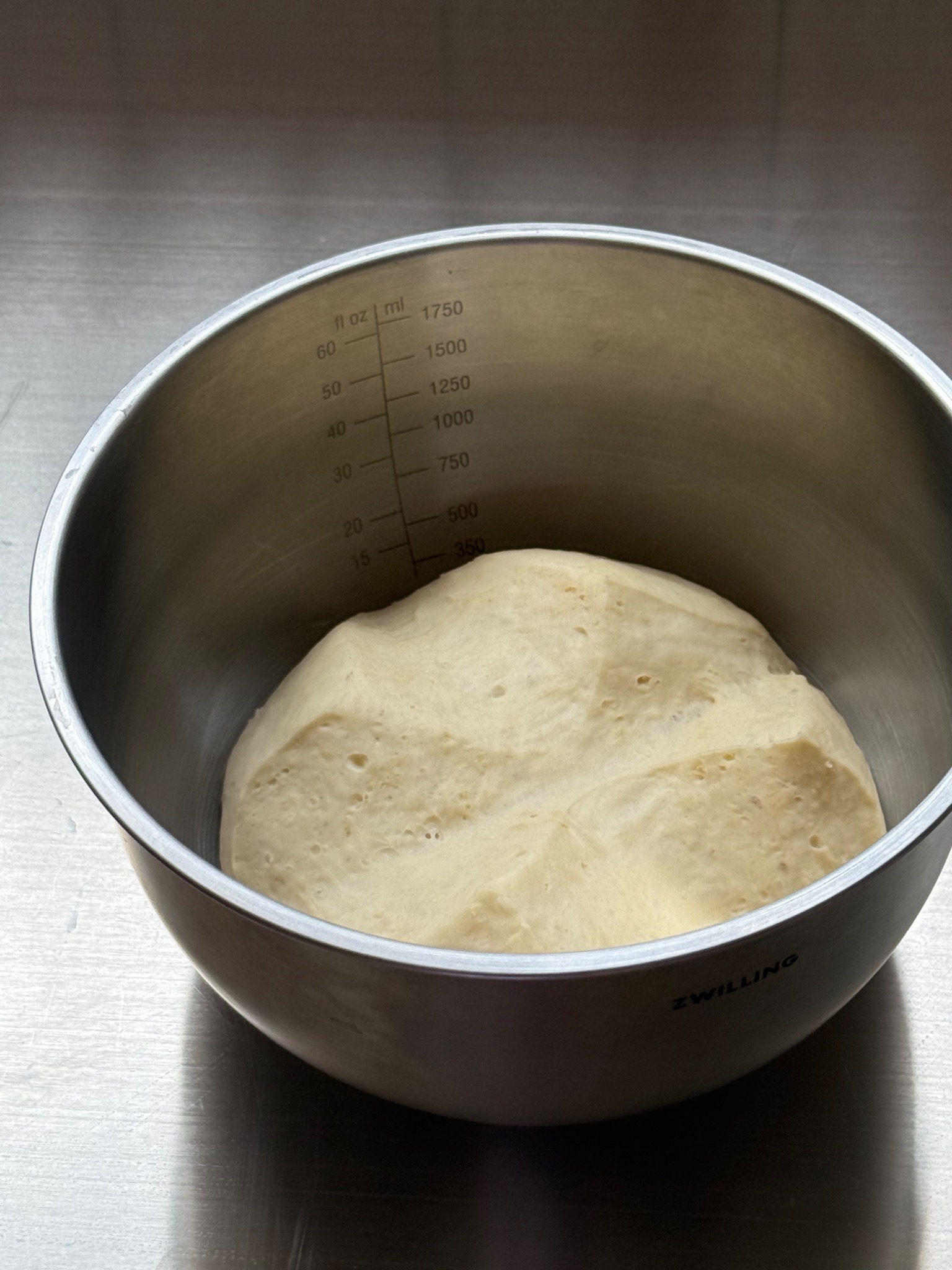
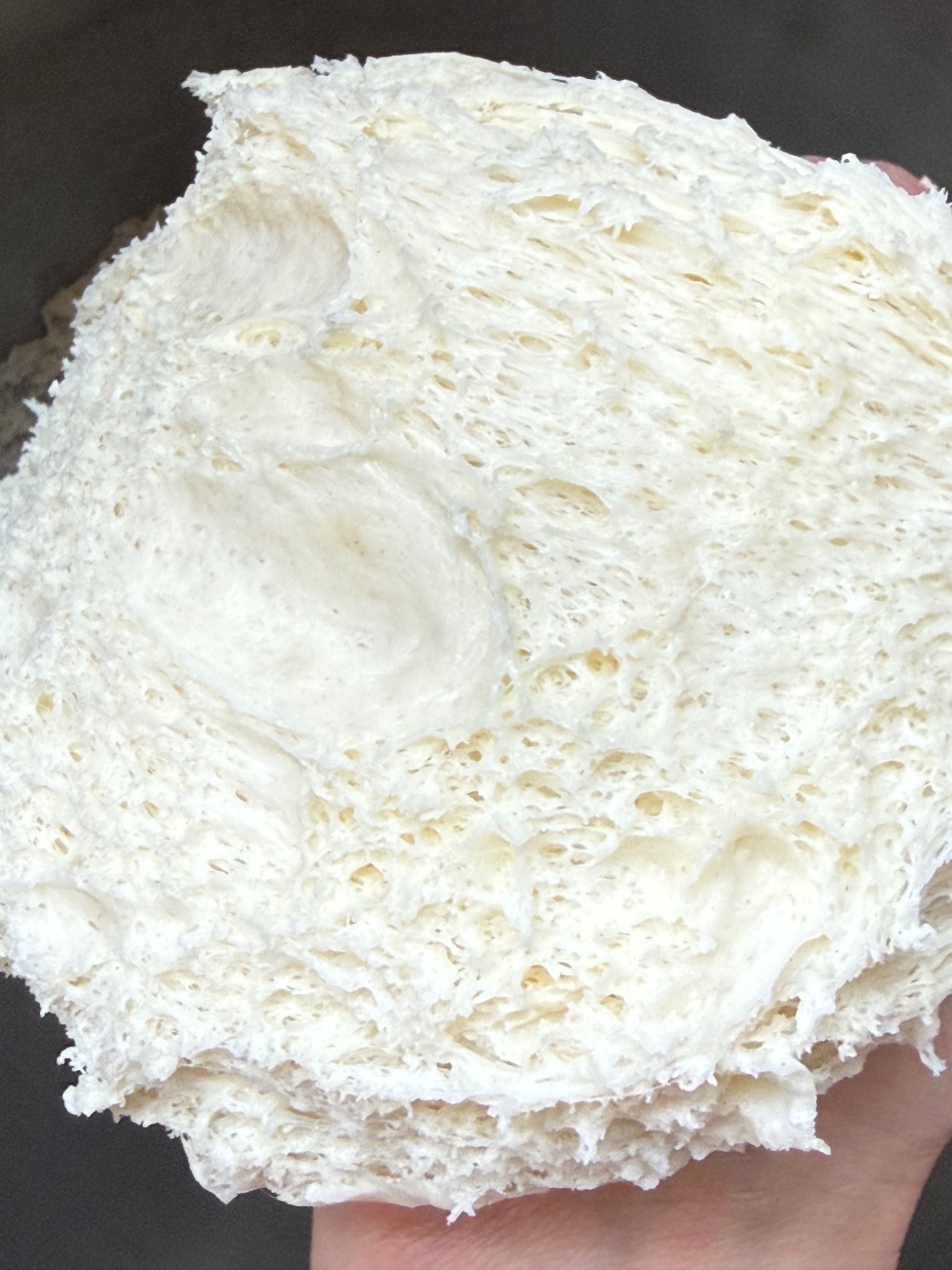
By the end of the second week, the starter should rise well, have a resilient and well-developed porous structure, feel non-sticky, and smell pleasantly lactic and bready.
After building: storing and refreshing
After the final feeding and a good rise, the starter can be stored in the refrigerator in a closed glass jar.
With proper care, Lievito Madre can live for decades. The important thing is to keep feeding it regularly.
If you bake often, you can refresh the starter as needed. After it has been stored in the refrigerator, it should be fed before baking so that it can regain its strength.
When I take mine out of the refrigerator, I first refresh it and watch how it behaves. If it rises well, feels resilient and porous inside, and smells pleasant and slightly tangy, I use the next feeding to build the amount I need for baking.
One benchmark for a mature and active Lievito Madre is its ability to roughly triple in volume within 4 hours at 26–28°C.
Over time, however, I stopped treating the clock as the only measure. I look at the starter itself: how it rises, what its structure is like, how it smells, and how pronounced its acidity has become.
When I am not baking
Even when I do not plan to bake during the week, the starter cannot be left unfed in the refrigerator indefinitely.
I keep around 20–25 g of Lievito Madre and try to refresh it about once a week, even when I am not planning to bake. This keeps the starter in good condition and prevents it from accumulating too much acidity.
Two refreshing ratios
For a regular refresh of a mature Lievito Madre, you can use a ratio of 1:1:0.5 — one part starter, one part flour, and half a part water.
For example:
30 g flour
15 g water
This makes 75 g of starter.
I find this amount especially convenient: I use 50 g for one loaf of bread and keep around 25 g in the refrigerator. That way, there is practically no excess starter.
Another option is a ratio of 1:2:1, in which the amount of fresh flour is doubled relative to the original starter.
For example:
50 g flour
25 g water
This makes 100 g of starter.
This refresh can also be used to correct a starter that has become too strong or acidic: the larger amount of fresh flour helps reduce the accumulated acidity.
In both ratios, the water is half the weight of the flour being added, maintaining 50% hydration.
When the starter becomes too acidic
During the first six months, my Lievito Madre became noticeably more acidic a couple of times.
Its smell changed, the starter turned greyish and sometimes sticky, and it rose less effectively after feeding. A sharp vinegary smell, a change in structure, and a noticeable loss of activity can indicate that the starter has fallen out of balance.
This can happen, for example, if the starter has been left unfed for too long.
In such cases, you can use a corrective procedure known as a starter bath.
Bathing the starter
A starter bath should not be done regularly or on a schedule. I use it only when I can see that the starter has become too acidic and a normal refresh is not enough.
- Cut the Lievito Madre into slices.
- Place it in water at 20–22°C, adding a small amount of sugar — around 2 g per litre of water.
- Leave it for 10–15 minutes.
- Remove the starter and gently squeeze out the excess water.
- Always refresh the starter after its bath.
Afterwards, I watch its condition and continue refreshing it until it begins to rise well again and returns to its usual resilient structure and pleasant aroma.
Over six months, my starter needed a bath only a few times — when its smell, structure, and behaviour made it clear that the acidity had moved in the wrong direction.
I hope this entry proves useful and inspiring. Grow your little bread Tamagotchis and share your results with me! And if questions come up along the way, we can always talk them through together :)
Happy to be of help,yours, Verunchik